Olympic at last!
Squash was for years the great omission from the Olympic programme. After several unsuccessful bids, it finally makes its Olympic debut at Los Angeles 2028. And it won't go unnoticed: the competition will be held at a venue on the Universal Studios lot, surrounded by Hollywood film sets.
- Two draws of 16 players, men's and women's singles.
- From 15 to 24 July 2028, ten days of competition.
- Evening sessions in Los Angeles, which means overnight and early morning in the UK. Catch-up will be your friend.
How do players qualify?
With just 16 places per draw, qualification is one of the toughest at the Games. Places come from continental games (five per gender), the professional world rankings (eight), one host country place, one universality place and a final qualifying tournament. Each nation can enter a maximum of two players per draw. Egypt, which has dominated the professional tour for years, starts as the clear favourite.
What about Britain?
Britain has one of the richest squash traditions in the world. England's Nick Matthew won three world titles, Laura Massaro reached world number one, and English players have long been at the top of the game. Whoever makes the GB team in 2028, every ranking point between now and then will count.
Read next⏱️ Los Angeles 2028 Olympics: the schedule in UK time→The rules in two minutes
Squash is played by two people in an enclosed, four-walled room: the court, 9.75 metres long and 6.4 metres wide. Both players share the same space and take turns hitting the ball against the front wall.
The basics
- The ball must hit the front wall above a low strip called the "tin" and below the out line.
- It can hit the side and back walls before or after the front wall, which creates fascinating angles.
- It can only bounce once on the floor before your opponent hits it. You can also volley it.
- You lose the rally if the ball bounces twice, hits the tin, goes out or fails to reach the front wall.
Serving
The server stands with one foot in the service box and hits the ball onto the front wall above the service line, so it lands in the back half of the court on the opposite side. Whoever wins the rally serves next.
Scoring
Every rally wins a point, whoever is serving. A game is won at 11 points, by a margin of two, and a match is usually the best of five games.
Lets and strokes
This is squash's most distinctive rule. Because both players share the court, each must give the other clear access to the ball. If a player is impeded, the rally is replayed (a "let") or awarded to them if their opponent prevented a winning shot (a "stroke"). Among friends, the rule is simple: if in doubt, play a let, and never risk hitting the other player with your racket.
Why take up squash?
- A brilliant workout: in 45 minutes you'll be working flat out. Squash is regularly cited among the best sports for all-round fitness.
- All year round: indoors, whatever the British weather, day or evening.
- You only need two: no team required. A colleague, a friend, your partner, and you're off.
- Fast progress: with the right ball, you'll be rallying in your first session.
- A tactical game: angles, drops, lobs. Like chess, you need to think a move ahead.
- A sensible budget: a racket, balls, indoor court shoes and court hire.
Where to play in the UK
The UK has thousands of squash courts, at dedicated clubs, leisure centres and some gyms. England Squash, Scottish Squash and Squash Wales list affiliated clubs, many of which run beginner courses, social sessions and friendly box leagues.
How to go about it
- Find a club or leisure centre near home or work: squash fits perfectly into a lunch break.
- Book a court for 45 minutes: the ideal length to start with. Rackets can often be borrowed or hired on site.
- Take a beginner's lesson: one or two sessions with a coach will stop bad habits forming.
- Join a club social night or box league to find players at your level.
Kit for beginners
The racket
There's no need to go top of the range to start with. A light racket, around 110 to 140 grams, with a fairly large head is forgiving on off-centre hits and kinder on your arm. The entry-level models from the big brands are perfect for starting out.
A very light, manoeuvrable racket with a generous head that makes those first rallies easier. A beginner's classic.
The ball: the most important choice
This is the number one beginner's mistake: playing with the professionals' ball. Squash balls differ in how much they bounce, often shown by a coloured dot.
- Beginner ball (often a blue or red dot, depending on the brand): it bounces a lot and gives you time to get into position.
- Intermediate ball (single yellow dot): for regular players.
- Competition ball (double yellow dot): it barely bounces and needs warming up with long rallies. Best left to experienced players.
Bigger and bouncier than the competition ball, it gives you time to play your shot and makes your first sessions far more enjoyable.
The double yellow dot ball used on the professional tour. Move up to it once your rallies are long and consistent.
Eye protection
A squash ball is small and can travel very fast in a confined space. Squash-specific protective eyewear is strongly recommended, and compulsory in some competitions, particularly for juniors. A small investment for real peace of mind.
World Squash Federation-approved eyewear, lightweight, with grippy arms and a retaining strap.
Footwear
Non-marking indoor court shoes, which don't leave marks on the wooden floor, are required on most courts. They also give you the grip you need to change direction. Running shoes, with little lateral support, aren't suitable.
Your first session
- Warm-up (10 minutes): a light jog, ankle, hip and shoulder mobility, a few lunges.
- Warm the ball up: a few gentle shots against the front wall so it bounces better.
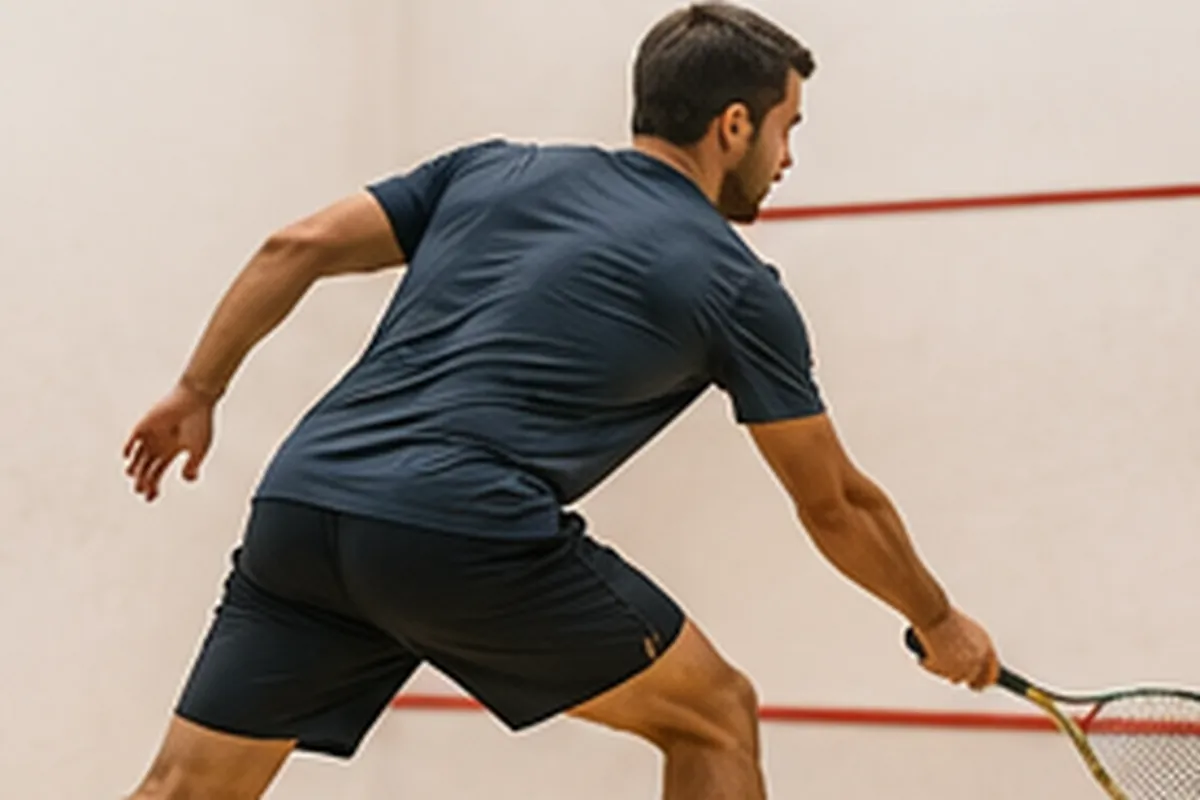
- The forehand drive: squash's basic shot, sending the ball tight to the side wall and away from your opponent.
- The backhand: the same movement on the other side. It soon becomes natural.
- Back to the "T": after every shot, return to the centre of the court where the lines meet. It's the secret of good players.
- Your first rallies: keep score if you like, but without pressure.
Safety and beginner's mistakes
- Playing without eyewear: protecting your eyes isn't a luxury.
- Swinging too big: an oversized swing can hit your opponent. The squash swing is compact.
- Staying at the back of the court: getting back to the T after every shot saves you running twice as far.
- Thinking tennis or padel fitness is enough: squash is far more intense. Start with 30 to 45-minute sessions.
- Forgetting to drink: you sweat a lot in an enclosed court.
Squash is very demanding on the heart and lungs. If you're returning to sport after a long break, are over 40 or have any health history, check with your GP and start with gentle rallies rather than competitive matches.
Your first four weeks
Consistency beats intensity. This simple plan will get you into the game without overdoing it:
- Week 1: two 30-minute sessions, just forehand and backhand drives with a beginner ball. No scoring.
- Week 2: two 40-minute sessions. Add serving and returning, and finish with a relaxed game.
- Week 3: one coached or group session and one free session with two short games. Focus on getting back to the T.
- Week 4: two 45-minute sessions with short matches. Once your rallies are regularly getting longer, try a single yellow dot ball.
A quick glossary for watching a match
- The T: the centre of the court, where every player wants to get back to.
- The tin: the low strip on the front wall. Hit it and you lose the rally.
- Length: a ball that runs along the side wall to the back of the court.
- Drop shot: a softly hit ball that dies just above the tin.
- Boast: a shot that hits a side wall before the front wall.
- Let and stroke: a replayed rally or a rally awarded after interference.
Watching Olympic squash from the sofa
Thanks to glass courts and cameras behind the front wall, squash makes great television. A few things to look out for:
- See who controls the T: whoever holds the centre of the court dictates the rally.
- Wait for the drop: after a series of length shots, the short ball that forces the opponent to sprint forward often makes the difference.
- Watch their legs: the movement of the top players is astonishing.
With the squash sessions falling overnight and early morning in the UK, catch-up will be the best option. And since squash won't necessarily be on free-to-air TV, our guide explains where to watch it.
Read next📺 How to watch the LA 2028 Olympics in the UK→A racket, two players, four walls: squash is probably the easiest Olympic sport to try next week. And you'll watch its Olympic debut with an expert eye.
Frequently asked questions
Is squash in the 2028 Olympics?
Yes, for the first time in its history. Squash makes its Olympic debut at Los Angeles 2028, with men's and women's singles draws of 16 players each, from 15 to 24 July 2028, at a venue on the Universal Studios lot.
Is squash hard for beginners?
Not if you use the right ball. Beginner balls bounce more and give you more time to play your shot. You'll be having rallies in your very first session and improving quickly.
Which squash ball should a beginner use?
A ball that bounces more than the competition ball, often marked with a blue or red dot depending on the brand. The double yellow dot ball used by professionals barely bounces and is best left to experienced players.
Do you need eye protection for squash?
It's strongly recommended, and compulsory in some competitions, particularly for juniors. The ball is small and fast, and squash-specific protective eyewear protects your eyes for a modest cost.
Is squash suitable after 40?
Yes, as long as you build up gradually. Squash is very demanding on the heart and lungs. After a long break or if you have any health history, check with your GP and start with gentle rallies before playing competitive matches.
Where can I play squash in the UK?
At squash clubs, leisure centres and some gyms. England Squash, Scottish Squash and Squash Wales list affiliated clubs, and you can usually book a court by the hour and borrow or hire a racket on site.
Sources
Information checked against the following sources (last checked: 22 November 2026):
- LA28, official website of the Los Angeles 2028 Games
- World Squash, the international governing body
- England Squash

Passionate about new tech and sport, we created PodiumSofa to bring the two together. We carefully select the screens, headphones and settings we recommend, and check every time against official sources. Find out more
Spotted a mistake or something out of date? Email us at contact@podiumsofa.eu and we'll fix it quickly. · How we choose
Was this page helpful?
Anonymous: no cookies, no IP address stored. Please don't include any personal details.
Some links on this page are Amazon affiliate links and are labelled as such. If you buy through them, the site may earn a commission at no extra cost to you. As an Amazon Associate we earn from qualifying purchases.